


Complete Car Documentation Checklist: What Every Buyer Must Verify
In Illinois, buying a car without proper documentation can leave you owning a vehicle with hidden liens, a salvage title you didn't know about, or one that can't be properly titled in your name. This checklist covers every document you must verify before handing over a single dollar.

Why Documentation is the Most Underrated Part of Buying a Car
Many buyers focus entirely on the car's condition and price — and completely skip document verification. This is one of the most expensive mistakes a buyer can make. Undisclosed liens, salvage titles, or odometer fraud can result in serious financial and legal complications after the sale.

The Essential Car Document Verification Checklist for Illinois Buyers
Go through each item on this checklist before finalizing any used car purchase. Never skip a single step — each document protects you from a different type of fraud or legal risk.
A comprehensive document checklist for used car buyers in Illinois, covering title verification, lien checks, VIN matching, odometer disclosure, and bill of sale requirements.
- The Vehicle Title
The Certificate of Title is the primary ownership document for any vehicle in Illinois. Verify that the name on the title matches the seller's valid government-issued photo ID. Check that the VIN on the title matches the VIN on the vehicle's dashboard (visible through the windshield) and door jamb sticker exactly. A mismatch is an immediate red flag — stop the transaction.
Also check the title type. An Illinois "Clean Title" is what you want. A "Salvage Title" or "Rebuilt Title" means the car was declared a total loss by an insurance company at some point. While rebuilt cars can be legitimate, they carry significant resale and financing challenges and should be priced significantly below clean-title equivalents.
- Run a CARFAX or AutoCheck Report
Using the VIN, pull a vehicle history report from CARFAX ($45 for one report, or $100 for unlimited reports) or AutoCheck. These reports reveal accident history, title issues, odometer discrepancies, previous state of registration, and number of previous owners. This is a non-negotiable step for any used car purchase.
- Check for Liens Through the Illinois Secretary of State
A lien means a bank or lender has a legal claim on the vehicle as collateral for an unpaid loan. In Illinois, you can check for active liens through the Secretary of State's office or by using a title search service. If there's an active lien, the seller must pay it off before or at the time of sale, and you should receive documentation confirming the lien release.
- Verify the Odometer Disclosure Statement
Federal law requires sellers to provide an Odometer Disclosure Statement for vehicles under 10 years old and under 16,000 lbs. The disclosed mileage must match the odometer reading. Cross-reference against the CARFAX report — any significant discrepancy in mileage history is a major red flag for odometer fraud.
- Bill of Sale
While Illinois does not require a notarized Bill of Sale for private party vehicle sales (unlike some other states), having one is strongly recommended. A Bill of Sale should include: the buyer's and seller's full legal names and addresses, the vehicle details (make, model, year, VIN, mileage), the agreed selling price, the date of sale, and both parties' signatures. This protects both buyer and seller in any post-sale dispute.
- Verify the Seller's Identity
Always verify that the person selling the car is the registered owner on the title. Ask for a valid government-issued photo ID and confirm the name matches the title exactly. If the seller is acting on behalf of the owner (as an agent or family member), require a notarized Power of Attorney authorizing them to sell the vehicle.
- Emissions and Safety Inspection Records
In Illinois, vehicles registered in counties within the Chicago metro area (Cook, DuPage, Kane, Lake, McHenry, and Will counties) are subject to biennial emissions testing. Ask for proof of the most recent emissions test pass. While this transfers with the vehicle, knowing its status helps you understand the car's maintenance history and plan for upcoming testing costs.
Read Latest Articles
Simple, transparent process that gets you the best price for your car
Mar 06 2026
Essential Vehicle History Reports Every US Seller Should Provide
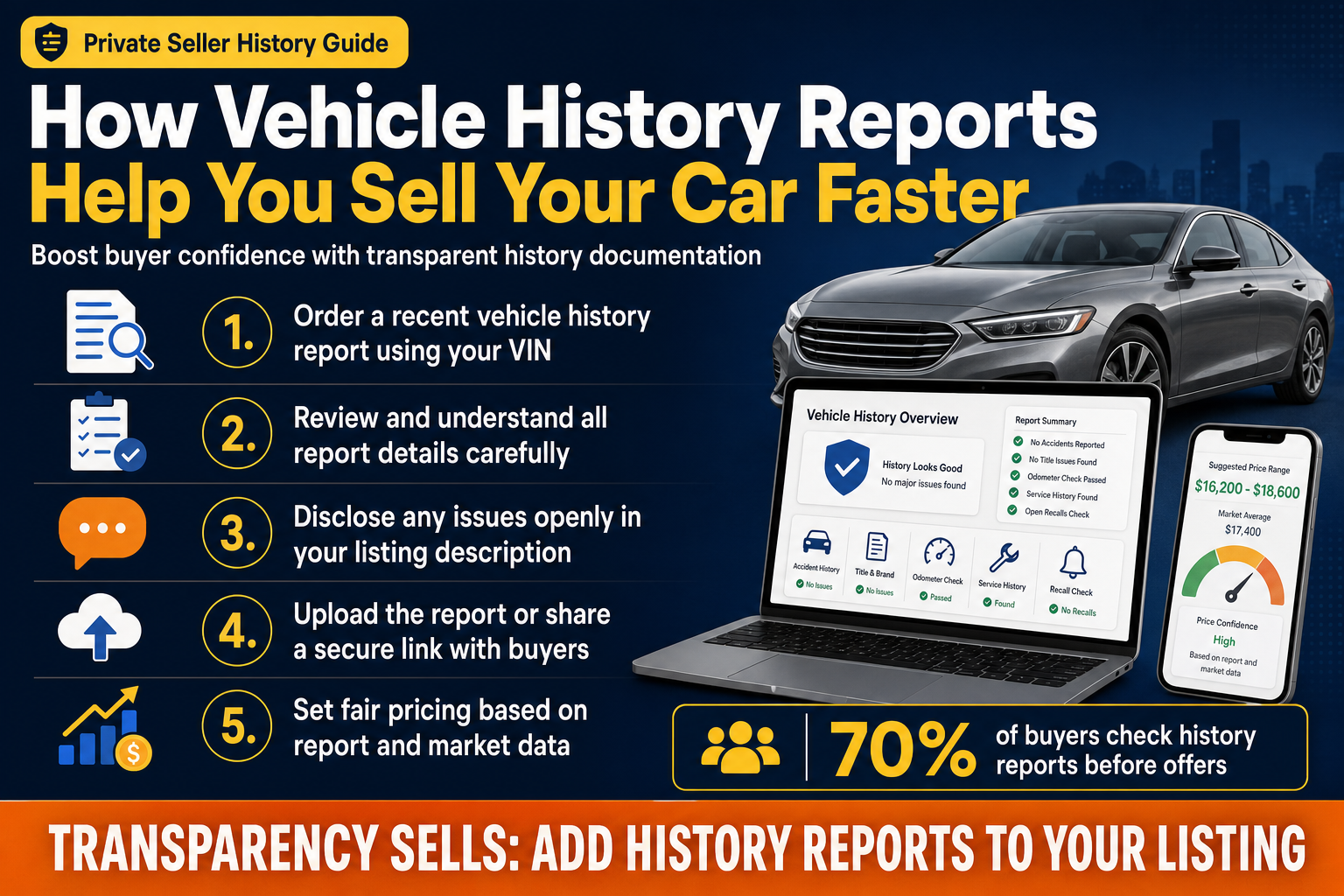
Selling your car privately? One of the most powerful tools to build trust and attract buyers is providing a detailed vehicle history report. These reports offer transparency about your car’s past — including accidents, title status, service records, and more — that buyers urgently want to know before making an offer. In this guide, you’ll learn exactly which vehicle history reports are important for US sellers, how to obtain them, and how to present this information effectively in your listings. We’ll also cover common pitfalls sellers face when they skip this step and how LazyChimp’s platform helps you showcase history reports to close sales faster. Ready to boost buyer confidence and sell smarter? Let’s dive into the must-have vehicle history documentation every private party seller should provide.
Anonymous
Read Article →
Mar 06 2026
How to Price Your Used Car Competitively for a Quick Private Sale
Selling your used car privately can be a rewarding way to get the best value, but setting the right price is crucial. Price it too high, and you risk scaring away potential buyers; price it too low, and you might leave money on the table.This guide walks you through practical steps to research and establish a competitive price for your vehicle. You'll learn how to balance market data, condition, and timing to attract serious buyers without undervaluing your car.By the end, you'll understand common pricing pitfalls to avoid and how tools like LazyChimp’s transparent pricing can give you an edge in today’s US car market.
Anonymous
Read Article →
Mar 06 2026
How to Price Your Used Car Competitively for a Faster Private Sale
Selling your car privately can be profitable, but pricing it right is crucial to attract buyers quickly. Overpricing means your vehicle sits on the market, while underpricing leaves money on the table. Understanding how to set a competitive price is key to a successful sale. In this guide, you will learn how to research market values, factor in your car’s condition, mileage, and location, and adjust your asking price strategically. We’ll also cover common pricing mistakes sellers make and share tips on how to leverage LazyChimp’s transparent pricing tools to your advantage. Whether you're selling a sedan, SUV, or pickup, this article provides actionable steps to price your used car competitively and sell faster without sacrificing value.
LazyChimp.Com
Read Article →